

How Should a Taekwondo Poomsae Uniform Fit for Competition Standards
2026-06-26
A Taekwondo Poomsae Uniform is not a casual training garment. In competition, every centimeter of fabric, every seam angle, and every collar stiffness directly influences judges’ perception and your own range of motion. Unlike sparring dobok—which prioritizes looseness for kicks—a competition Taekwondo Poomsae Uniform must balance crisp lines, aerodynamic silence, and rigid formality. This guide breaks down the exact fit standards used by national team selectors, with practical references from WOOSUNG, a brand whose competition-grade uniforms are worn by multiple Asian championship medalists.
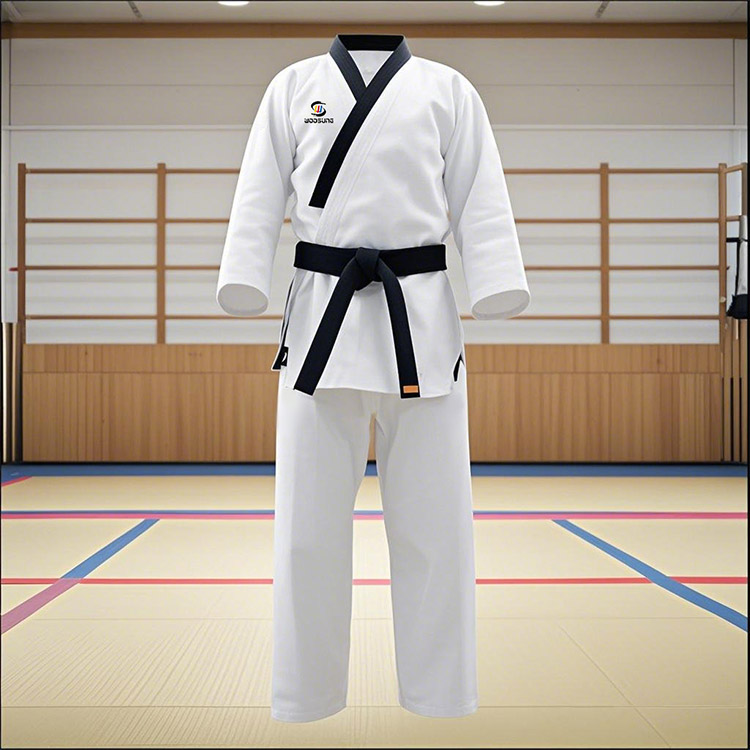
The Three Non‑Negotiable Fit Zones
| Fit Zone | Competition Requirement | Common Mistake |
|---|---|---|
| Jacket torso length | Covers hip bone completely when arms are raised | Riding up above the belt line |
| Sleeve cuff | Ends 2–3 cm above the wrist bone | Covering the palm or hanging past the thumb base |
| Trouser inseam | Hangs straight to the top of the foot arch | Pooling on the instep or stopping above the ankle |
Jacket Fit: The “Static Snap” Test
When you stand in attention posture (Joonbi), the front overlap of your Taekwondo Poomsae Uniform must stay flat against your chest without gaping. WOOSUNG competition models use a higher-density poly-cotton blend in the chest panel specifically to prevent sagging.
Perform this field test: raise both arms to shoulder height, then snap them downward. If the jacket produces a loud “pop” from fabric slapping your ribs, the torso is too wide. If you feel tension across your shoulder blades, the armhole is too narrow—you will lose 0.3–0.5 seconds in turning techniques, which directly reduces your execution score.
Trouser Fit: Mobility Without Baggage
The lower garment of any Taekwondo Poomsae Uniform must allow a full front split (seated straddle) without tearing the crotch seam. However, excess fabric around the thighs creates drag during side kicks (Yop Chagi) and obscures knee alignment—a common deduction point.
WOOSUNG solves this by adding a gusseted crotch panel that adds 4 cm of depth while keeping the leg silhouette tapered. For competition, the hem should lightly brush the top of your foot, not cover the laces. If you can pinch more than 3 cm of fabric at the outer thigh when standing naturally, the size is too large.
Collar and Closure Rules
World Taekwondo (WT) competition guidelines do not mandate a specific collar type, but elite judges visibly prefer the V‑neck over the traditional crossover. Why? The V‑neck creates a longer vertical line, making torso twists appear more pronounced—a visual advantage in speed-based poomsae.
A competition‑grade Taekwondo Poomsae Uniform must have a stiff inner collar band (minimum 2.5 cm width) that does not flop forward when you bow. WOOSUNG embeds a heat-set interfacing inside the collar, which holds its 90‑degree angle even after 50 wash cycles.
Sizing Reference Table (Adult Male/Female)
| Body Height (cm) | WOOSUNG Size | Jacket Length (cm) | Inseam (cm) | Sleeve Length (cm) |
|---|---|---|---|---|
| 155–163 | 160 | 72 | 74 | 56 |
| 164–172 | 170 | 76 | 78 | 58 |
| 173–180 | 180 | 80 | 82 | 60 |
| 181–188 | 190 | 84 | 86 | 62 |
Note: Always size up if you compete in humid climates—cotton shrinks 3–5% in the first hot wash. WOOSUNG pre‑shrinks their competition fabric to minimize this risk.
The Sound and Visual Check
During a poomsae round, judges listen for the “whoosh” of fast arm strikes. A loose Taekwondo Poomsae Uniform produces a muffled, flapping sound. A correctly fitted one emits a sharp, clean whisk—proof that the fabric is skimming your skin without resistance.
Visually, your belt should sit exactly at your navel level. If the jacket’s lower hem rises above your belt when you perform a back stance (Dwit Kubi), the torso length is too short—an immediate deduction for “unclean silhouette” under the current WT judging criteria.
Taekwondo Poomsae Uniform FAQ
Q: Can I wear my training dobok for a national-level poomsae competition, or do I need a specific competition uniform?
A: You can technically wear any WT‑approved dobok, but training uniforms use softer, heavier cotton that absorbs sweat and clings to your body mid‑routine. A dedicated Taekwondo Poomsae Uniform uses lightweight (under 180 gsm) ripstop or micro‑polyester that dries instantly and maintains a stiff collar. Training doboks also lack the tapered sleeves that judges visually expect. For national events, over 90% of finalists wear a poomsae‑specific model—not because rules require it, but because the fabric dynamics directly improve snap speed and visual clarity. WOOSUNG’s competition line is explicitly certified for WT‑sanctioned tournaments, meaning the seam allowances and panel cuts meet the federation’s technical inspection checklist.
Q: How much room should I leave for growth or layering if I’m between two sizes?
A: Always choose the smaller size if your measurements fall in the upper third of a size range, provided you can perform a full squat without crotch tension. Layering is not allowed in competition—you wear only the uniform and an undershirt (plain white, no logos). For a growing junior athlete, size up only if the jacket length exceeds your hip bone by less than 2 cm. A Taekwondo Poomsae Uniform that is one size too large ruins the “sharp angle” effect for front kicks and slows your turning speed by approximately 0.2 seconds per 180‑degree rotation—enough to drop your score from 8.5 to 8.2 in a highly competitive pool. If you insist on sizing up, choose a brand like WOOSUNG that offers half‑size increments (e.g., 175 instead of 170 or 180) to bridge the gap.
Q: Does the uniform fit change if I compete in the over‑30 senior division versus the under‑18 junior division?
A: Yes, significantly. The WT competition standards do not change, but body composition does. Senior athletes (over 30) typically have broader shoulders and a shorter torso relative to leg length, so a standard size 180 may pull at the armpits even if the inseam fits perfectly. Junior athletes (under 18) often have longer limbs for their height, requiring a taller size but a narrower chest cut. The solution is to measure your apex-to-apex (chest width) and inseam-to-height ratio. For seniors, WOOSUNG offers a “Stocky” variant with an extra 3 cm in the chest and 2 cm shorter in the torso. For juniors, the “Lanky” variant adds 4 cm to sleeves while keeping the chest tight. Always request the competition‑fit chart from your supplier—generic size charts are designed for training uniforms, not for the specific biomechanics of poomsae.
Final Checklist Before Packing for a Tournament
-
Jacket hem stays below belt when both arms are fully extended overhead.
-
Sleeve cuffs clear your watch/wristband area.
-
Trouser legs do not touch the floor when you kneel.
-
Collar stands upright without finger support.
-
Fabric passes the “pinch test” (less than 2.5 cm excess at waist sides).
A properly fitted Taekwondo Poomsae Uniform is not a luxury—it is a scoring tool. WOOSUNG engineers each seam with input from former national poomsae coaches, ensuring that every fold corresponds to a specific movement axis.
Ready to lock in your competition fit? Contact our team directly for a one‑on‑one virtual sizing session—we will compare your body measurements against the actual WT inspection template. Reach out to WOOSUNG through the contact form on our official page, or email us with your height, chest, and inseam numbers. We reply within 4 business hours with a personalized size recommendation and fabric swatch options. Your next score line starts with the uniform on your back—let us make sure it fits like a gold medal.